A few years ago I received a writeup about the Five Tibetan Rites in PDF form as a bonus for purchasing an ebook about composting. It is an interesting story about an older man who learns five basic exercises that are credited with keeping a group of monks in Tibet young and very fit as long as they live. The exercises are fairly simple but they are invigorating and I’ve been doing them almost daily since then – sometimes I use them as a warmup for working out or a pick me up if I get tired in the afternoon. I’ve lost the soft copy of that writeup since then but I found another one that I’m providing as a free download at the end of this post.
The article is based on a book called “Eye of Revelation”, which is a good story whether you believe it to be true or not. I can say from experience that the exercises are very easy to do and help me feel better in general every time I do them. The five rites are like yoga exercises, good for both flexibility and core strength.
In the writeup I found, there is a sixth exercise mentioned which reminds me of the Buteyko breathing techniques I also learned about several years ago – see image link to the left, which is based on the research of a Russian doctor named Konstantin Buteyko. You can learn more about his research and legacy at buteyko.com. I’ve used the buteyko method to help me overcome sinus infections, nasal allergies, and even just clear blocked nostrils. I try to breath through my nose all the time now, even when I workout – I’ve found that I have more stamina that way (for example while doing circles on the mushroom).
So if you haven’t yet, download and take a look at the pdf document about the Five Tibetan Rites here. They are a good complement to any workout routine.
originally posted at https://www.goodfeelingplace.com/my-gymnastics-rings
This year my wife got me a pair of rings for fathers day, exactly like the ones you can see to the right. I thought it was great but the only place I had to hang them at the time was on a chinup bar in a doorway. That was kind of neat, the kids enjoyed it, but it was pretty low to the ground with limited space and the straps were way too long for that setup (and I didn’t want to cut them yet).
In the fall when it began to cool down here in Phoenix I began planning how I would set them up in the garage. I think it was sometime in late October when I got them installed there. I secured a metal pipe to the ceiling using so many bolts that I could probably hoist a car on it (see image below).
Rings secured to the ceiling in the garage
Although I setup the rings for myself, my kids (and their friends) kind of took over. I was relegated to being the traffic cop to tell the kids when their turn is up and make sure no one cuts in line. I think it’s like having a roller coaster ride in your backyard with only one seat in it. You can see how my youngest son Hani spins in the first video below, and one of my older sons Demitri is in the next video.
However, on Thanksgiving day a few weeks ago I decided that I would put together a routine on rings and compete again at the Rocky Mountain Open in January 2011. That’s the same competition I had planned to compete in on pommel horse this year, until I got discouraged by how much different circles on the mushroom are to circles on the horse (I challenged the Arizona State University team to a circle contest in late 2009 after doing 74 on my mushroom at home, but was only able to do 46 on the horse when I got to the gym).
About a week before Thanksgiving I had began listening to the guided meditations CD from the Getting into the Vortex book (as pictured to the right). We had recently gotten all our kids out of diapers (after almost 9 years of having at least one child in diapers), so I was feeling very good about life. I continue to listen to the guided meditations because it helps me to see past any negative thoughts in my mind and to look towards emotional freedom and infinite possibilities in my life. It was in this context that I decided I could compete again.
Last Friday I went to Aspire to workout with the current ASU gymnastics team, which is 28 members strong now. I was very excited, so much so that I forgot my grips at home. Fortunately they have a well stocked lost and found bucket and I was able to procure a decent pair of ring grips to swing with. I wanted to practice swinging (like giant swings, which I don’t have the height for in my garage) and also get an update to the routine requirements, which I know have changed a great deal since I competed.
Scott (the ASU head coach, who was my coach 10 years ago when I was in college) gave me the rundown on the current requirements and answered some questions I had, then I watched some of the guys practice their routines to get an idea of how they are put together. I also got a chance to do some tricks I hadn’t done in 10 years. I found that as a general rule I was about half a rotation slow on any flip (I only dismounted into the pit for this reason), but I was pleased to discover that I could adjust and tune myself quickly – for example after about 20 minutes on the tramp and then tumble trak I was able to do a standing back flip on the floor again.
I had a great time at the gym, then I went home and felt like I had been run over. I took a long hot bath with epsom salt (I picked up 2 large bags at walgreens because I figured I’d need more later) to help my body to recover, and now a few days later I’m no longer sore and ready to continue my strength training at home. I’ll return to the gym once I have a plan for a routine with several strength moves in it that I can do at home – probably next week.
Dec 20th, 2010 Update: I was pleased to discover that I could do both dips and pullups on the rings with my son Hani (in the first video above) on my back when we were playing on the rings over the weekend. I’ve also gained about 5 pounds since I began training in earnest (at least 20-30 minutes a day) – I’m naturally underweight so I’m happy to gain weight while exercising. I’m planning to go back to the gym Wednesday, and I will work on putting together the following skills for a routine: Kip L-Cross, Backuprise L-Cross, Backuprise Straddle L, Press to handstand, Front Giant, Back Giant, Tucked Yamawaki, Backuprise Planche, Pike Press to Handstand, Double Back Dismount.
The above routine is scalable so next year I can replace the strength moves with more difficult ones as I’m able to do them.
Dec 23rd, 2010 Update: I was able to do about 5 of those tricks above in sequence yesterday, but I need to make some modifications so it will flow better. I bought my plane ticket today to travel with the ASU team to the meet, I figure I will get 2-3 more chances to go to the gym and fine tune a routine before then. 🙂
Jan 2011 Update: I did compete at the Rocky Mountain Open, you can see the video in my review of the meet.
Later, in 2016, I moved the rings to my bedroom and added a few pieces to allow the straps to spin freely. I added a PVC pipe around the steel pipe and 2 plastic bushings to keep the straps from getting caught on the sides:
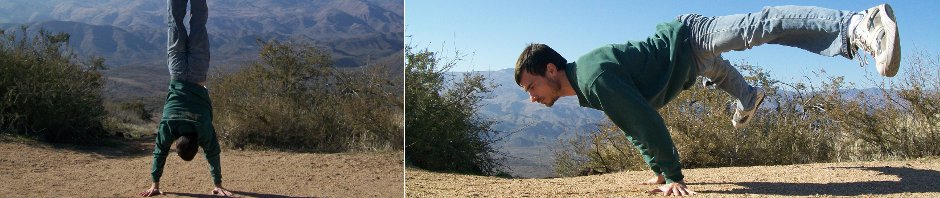
originally posted at https://www.goodfeelingplace.com/how-to-hold-a-handstand Since I challenged the ASU men’s gymnastics team to a pommel horse circle competition a few months ago I’ve learned a great lesson about flexibility. I was training on a mushroom leading up to the day I went into the gym, but after doing 74 circles on the mushroom I was only able to do 46 circles on the pommel horse when I went to the gym.
Then I began training with the mushroom top on the floor, but after a week or two I hit a barrier at 39 circles and realized that my inflexible wrists were preventing me from keeping my legs straight. Because of this, I decided to stop doing circles and focus on my wrist flexibility. I decided that I would be ready to do circles again when I was able to hold a handstand for a minute or two, so that was my goal and today I did a press handstand, got it on film, and posted my first video on Youtube:
originally posted at http://www.goodfeelingplace.com/the-key-to-flexibility-is-untimed-stretching
When splits training if part of your life, you don’t need to count the seconds. 🙂 Photo by Robin Poort on Unsplash
When I was a freshman in college, I sustained a head injury from a car accident which required me to relearn many basic functions, including walking, talking, and writing with a pencil. Arizona State University (where I went to school) has a very good disability support system. Due to my injury which happened over Christmas break, I was allowed to take untimed tests that spring. For most classes that didn’t matter, but for Physics that is the main reason I got an A in that class – hardly anyone finished those tests, but I remember sitting in the disabilities center for about 3 hours to finish each one.
That semester I didn’t get to compete on the gymnastics team either, but I did spend time in the gym, mostly stretching. Once I was able to workout again I was more flexible than before, which was great. I learned a great deal about how to improve flexibility from the times I was injured in college and could only stretch.
I learned that holding a stretch for 30 seconds or a minute during group stretches (where everyone is doing the same stretch) is much less effective than settling into a stretch and just relaxing and letting the world go by as if you weren’t there. Reading a book, talking to a friend, or even watching TV while stretching is great, so you can take your mind off it and relax.
These days, as I am doing circles on my mushroom almost everyday, I stretch for awhile soon after doing circles when my heart slows down a bit, and I also stretch at night before going to bed. I was just stretching at night, but since I’ve started doing circles again I know that I need to stretch my wrists right after working out in order to not tighten up. That way my nightly stretching can be helping me get more flexible instead of just catching up from the workout of the day (working out tightens muscles in general, so stretching is good to do after any type of workout).
So the next time you workout and feel the rush of endorphins, take the time to stretch and enjoy the natural, relaxing, good feelings of a healthy body. It will help you keep the good vibes going longer. If you want to gain flexibility, also pick another time in the day when you can either relax and meditate, or engage your thoughts in something else (like a book, homework, tv, or talking with a friend) while you stretch.
Mental blocks can come in many forms, but they all get fueled by the thoughts we think. Writers get “writer’s block”, actors get “stage fright”, and gymnasts (as well as other athletes) can develop an irrational fear about one specific trick or movement – like doing back handsprings on floor or beam, or doing release moves on the high bar or uneven bars. Depending on the skill, some may argue that fear is very rational, but it is still a mental game whether the fears are rational or not.
I have often been asked about how to overcome mental blocks by gymnasts or their concerned parents, so I thought I would write a thorough post about the subject here that I can refer to.
Fear is a very powerful emotion that takes a little while to overcome. On the emotional scale where feeling empowered is at the top (love, joy, and appreciation are all empowering), fear is at the bottom. The following list of emotions is on page 114 of the book Ask and It Is Given:
1.
Joy/Appreciation/Empowered/Freedom/Love
2.
Passion
3.
Enthusiasm/Eagerness/Happiness
4.
Positive Expectation/Belief
5.
Optimism
6.
Hopefulness
7.
Contentment
8.
Boredom
9.
Pessimism
10.
Frustration/Irritation/Impatience
11.
Overwhelment
12.
Disappointment
13.
Doubt
14.
Worry
15.
Blame
16.
Discouragement
17.
Anger
18.
Revenge
19.
Hatred/Rage
20.
Jealousy
21.
Insecurity/Guilt/Unworthiness
22.
Fear/Grief/Depression/Despair/Powerlessness
“Ask and it is Given” is a wonderful reference for practical mind games you can play to help you feel better about any subject.
Jumping Off a Cliff
I remember going hiking with my ASU gymnastics teammates about 10 years ago in Oak Creek Canyon. There was a waterfall at one point of the hike and we stopped to take a look. Some of the guys decided it would be fun to jump off the ledge right next to the waterfall (about 30 feet up) into the pool down below.
I looked over the edge and was gripped with fear. So I sat back on a rock several feet away while others jumped off and climbed back up a few times. I gave no indication that I was going to jump, and eventually people stopped egging me on. I sat very still and calmed my breath, focusing my attention on the ground beneath my feet. After awhile I had calmed down and was able to focus on the fact that the others were jumping and safely landing in the water below. I eventually worked my way up to feeling hopeful that I could do it too.
Without any warning, when there was no one getting ready to jump or getting out of the water, I stood up and quietly walked off the ledge. My teammates were freaking out when I re-emerged. They didn’t expect me to jump and I barely missed the rocks on the way down (because I didn’t jump I just walked off). At that point I didn’t care because I had jumped once and was done. 🙂
Mind Games
I remember having several other mental blocks with specific gymnastics skills (like every release move I ever tried on high bar!). These are actions to take over and over (not just once with the cliff jumping example above). The most success I had overcoming these mental blocks happened over periods of time when I could “play” with different aspects of the skills (either in my mind or on the equipment). The key was to not really focus on them or bring attention to the fact that I was playing with them. Just like in the example above, I had to remove myself from the situation and work my way up the emotional scale on my own (without the pressure or attention of anyone else) before I could approach it from a different perspective. Then once I felt better about it I would try it on my own (or ask for a spot if I was ready for that), but without much fanfare.
Taking a Break
Regarding specific gymnastics skills (like backwards tumbling, cartwheels, kips, jumping from the low bar to the high bar, release moves, etc.), I have the following belief. When a mental block is developed, a break is needed from whatever skill it is. This allows focus on other skills that are easier and very comfortable. Recently I’ve been skateboarding for fun at a skate park near my house. It helps me to do something which is totally different from my work or family life. This gives me a fresh perspective on whatever I get stuck on, whether it’s a programming issue or a parenting one.
The length of the break really depends on how long it takes to feel better. In the example above I was able to feel better about jumping off a cliff in a matter of minutes. But when I practice fearful thoughts about a given subject, it may take some time to believe different thoughts that are more hopeful and empowering.
It can help to talk about the subject, if the people you talk with can help you reach for thoughts that feel better. However, it is not necessary. I will even hinder progress if you talk to a person frustrated about the situation. The most important person to talk to is yourself.